In this article I am going to introduce fsm-designer, which is a small Angular application for creating State Machine Diagrams. The article also serves as a quick introduction to modeling systems as State Machines.
All code can be found in a Git repository at:
Table of contents
What are State Machines?
A useful tool for implementing and visualizing systems are so called State Machines. It's a very simple way to think of your system as so called States, Transitions and Actions. I think it's best unterstood using an example.
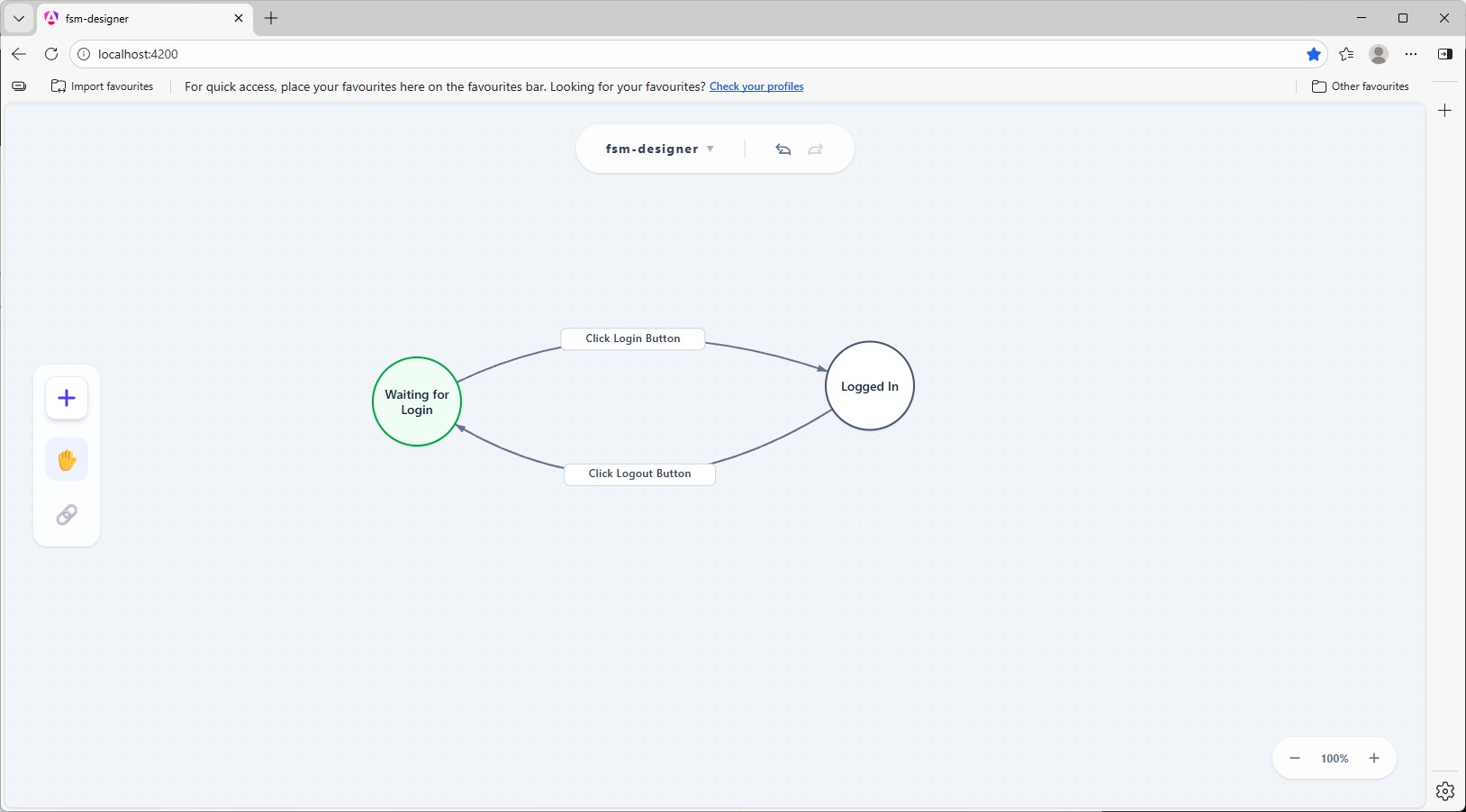
Let's say your application has just been started and the user is greeted with login screen. In
terms of a State Machine our application is now in a State called Waiting for Login or
similar.
The user then enters their credentials and clicks the login button. In the background our application
fires requests to a server and the user is redirected to a Dashboard. In State Machine lingo we could
say: "The application transitions from State Waiting for Login to State Logged In by an
Action clicking on the Login Button.
And that's all there is.
Of course the mathematically correct definition is slightly more complicated:
A finite-state machine (FSM) or finite-state automaton (FSA, plural: automata), finite automaton, or simply a state machine, is a mathematical model of computation. It is an abstract machine that can be in exactly one of a finite number of states at any given time. The FSM can change from one state to another in response to some inputs; the change from one state to another is called a transition.
What we are going to build
If you are going to implement a State Machine, there are a lot of useful libraries and countless of applications. But I always felt them to be overly complicated for simple diagrams. So I've developed fsm-designer, which is a small Angular application to visualize state machines:
Trying it out
You can use the fsm-designer here:
It does not send any data to a server and does not execute any network requests.